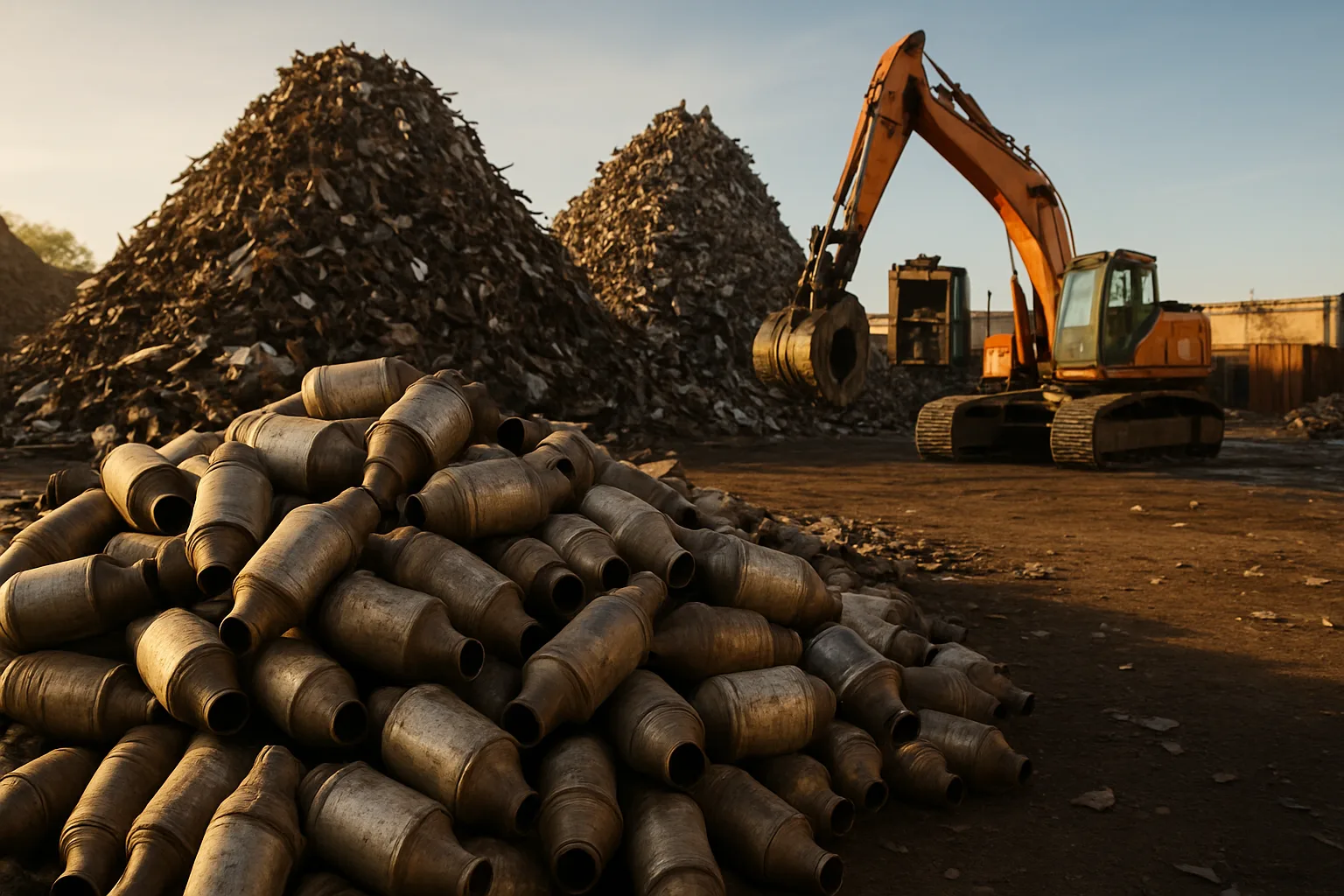
Why Your Catalytic Converter Is Worth More Than You Think — And Why Prices Keep Changing
Most people pulling a catalytic converter off a vehicle have no idea what's actually inside it. They know it's worth something. They just don't know why — or why the price they got quoted today is different from what a buddy got last month. That gap in knowledge costs sellers real money. Understanding how catalytic converter recycling actually works puts you in a better position every time you sell.
If you're in Fort Lauderdale or anywhere across Florida dealing in used vehicles, salvage, or scrap, this is worth reading carefully. The market for cats is more complex than copper pipe or aluminum rims — and that complexity creates both risk and opportunity.
What's Actually Inside a Catalytic Converter
The value in a catalytic converter doesn't come from its steel shell. It comes from the platinum group metals (PGMs) coated onto the ceramic or metallic substrate inside. Those three metals — platinum, palladium, and rhodium — are what refiners are actually buying when they process your cats.
The amounts are small but significant. A typical catalytic converter contains anywhere from 1 to 7 grams of PGMs depending on the vehicle make, model, engine size, and age. Some diesel-era units carry more. Hybrid vehicles often carry higher concentrations because their converters work harder and are engineered differently. That's why a Toyota Prius cat commands a dramatically different price than one pulled from a mid-size sedan.
- Platinum — used primarily in diesel catalysts; prices fluctuate with industrial demand
- Palladium — dominant in gasoline catalysts; historically volatile pricing
- Rhodium — the most valuable of the three; a small change in rhodium price swings cat values significantly
When a recycler receives your converter, it gets processed — either assayed on-site or sent to a refinery for full analysis. The refiner determines the exact PGM content and pays based on that. Every step between you and that refinery is a margin extraction point. The more steps, the less you see.
Why Catalytic Converter Prices Vary So Widely
If you've ever gotten three different quotes for the same cat, you already know the pricing inconsistency is real. Here's why it happens.
1. PGM spot prices move constantly. Palladium and rhodium prices can shift dramatically over weeks or months. A converter worth a strong number in January may be quoted lower by spring if rhodium pulls back. Unlike copper scrap, which tracks a relatively accessible commodity price, PGM pricing is less visible to the average seller — which makes it easy for buyers to obscure what they're actually paying.
2. Not all buyers have the same access to refineries. A small local yard may be reselling your cat to a mid-level aggregator who resells to a national processor who finally sends it to a refinery. Each handoff takes a cut. Buyers with direct refinery relationships can pay more because they're keeping more of the margin.
3. Identification matters. A buyer who can accurately identify your converter — using its serial number, the vehicle's VIN, or a converter-specific database — can pay a more accurate price. Buyers who guess pay conservatively. If they're guessing low, you're the one absorbing that uncertainty.
4. Volume and consistency matter to buyers. Yards moving high volumes of cats can negotiate better refinery terms. If you're selling one-off units, you're often at the bottom of the pricing tier regardless of market conditions.
This is exactly where platforms like the SMASH scrap metal auction marketplace change the dynamic. When multiple vetted buyers compete for your inventory — including catalytic converters — the price discovery process becomes transparent. Competition reveals what the market is actually willing to pay, rather than what one buyer feels like offering today.
How the Recycling Process Works — From Your Yard to the Refinery
Understanding the chain helps you understand where value gets captured and where it leaks.
- Collection and sorting — Converters are pulled from vehicles and sorted by type. Foil-substrate units process differently than ceramic. Some yards separate by manufacturer or known vehicle type.
- De-canning (optional) — The steel outer shell can be cut away, separating the ceramic or metallic substrate. This reduces shipping weight. Some processors prefer whole units; others prefer de-canned material.
- Sampling and assay — Converters are crushed, homogenized, and sampled to determine PGM concentration. This is the most critical step for pricing. Accurate assays mean accurate settlements.
- Smelting and refining — The PGMs are extracted through chemical and thermal processes. Final metal is recovered and valued against spot price.
- Settlement — The seller receives payment based on the assay results and agreed-upon refinery terms. Settlement timelines vary — typically 30 to 90 days depending on the processor.
The steel shell from de-canned converters isn't worthless either. It goes into the general scrap steel stream. While it won't move the needle on a high-value cat load, tracking it as part of your total recovery makes sense on volume. Yards in Fort Lauderdale handling salvage vehicles can stack these incremental recoveries across a week's worth of pulls and see it add up.
Documentation, Serial Tracking, and Why It Protects You
Catalytic converter theft has driven significant regulatory changes across the US over the past few years. By 2026, most states — including Florida — require buyers to maintain detailed records of catalytic converter purchases, including seller identification, vehicle VIN data, and photo documentation in many cases.
This isn't just a compliance burden. Done right, it's a selling advantage. When your inventory is properly documented — serial numbers recorded, VINs matched, photos attached — buyers have more confidence in what they're purchasing. More confidence typically means better offers. A load of well-documented cats is a lower-risk purchase for a buyer than a pile of unmarked units with no chain of custody.
SMASH builds this kind of documentation into the platform. Serial tracking, photo documentation, and VIN lookup are part of the inventory workflow — not an afterthought. That matters when you're trying to sell your scrap metal at top prices on Sell Scrap Metal and need your documentation to hold up to buyer scrutiny.
For yards operating in Fort Lauderdale or elsewhere in Florida, staying current on state-level compliance requirements isn't optional. Florida has enforced catalytic converter purchase regulations with real consequences for non-compliant yards. Build the documentation habit now and it becomes a competitive advantage, not just a legal checkbox.
Selling Catalytic Converters Through a Scrap Metal Auction — What to Expect
The traditional approach to selling cats is straightforward: call your buyer, get a quote, take it or leave it. That model benefits the buyer, not you. You have no way of knowing if the quote is competitive. You have no leverage. And if your usual buyer is having a slow month or managing their own inventory constraints, you may be leaving real value behind.
A scrap metal auction format flips that dynamic. Your converter inventory gets in front of multiple vetted buyers simultaneously. They bid. You see the results. The best offer wins. That's price discovery working the way it's supposed to work.
This is especially valuable for non-standard units — rare makes, older vehicles, or mixed loads where a single buyer might lowball out of uncertainty. When multiple buyers with different refinery relationships are competing, the buyer who knows exactly what they have pays accordingly. You benefit from their knowledge rather than getting penalized for theirs.
If you're ready to move inventory more efficiently, get a fair price for your scrap today by connecting with buyers through a platform built for this market — not a generic listing site. And if you want to dig deeper into how scrap selling works across metal categories, explore scrap metal selling guides for practical breakdowns from copper to catalytic converters.
For Fort Lauderdale yards managing mixed loads — cats alongside aluminum rims, copper wire, and scrap steel — running those categories through a competitive auction means better outcomes across the board, not just on one line item.
What Moves Catalytic Converter Prices Right Now in 2026
The PGM market in 2026 continues to be influenced by several intersecting forces. Electric vehicle adoption has reduced demand for new catalysts in some segments, putting mild downward pressure on certain PGM applications. At the same time, tighter emissions regulations in key global markets have sustained demand for high-loading catalysts in the vehicle segments still running combustion engines.
Rhodium pricing remains the wild card. It's thinly traded, highly sensitive to automotive production cycles, and can move sharply on supply disruptions. Palladium has tracked differently — its relationship to gasoline vehicle demand means it's watching EV transition timelines closely. Platinum has benefited from growing hydrogen economy interest, adding a floor that didn't exist a decade ago.
For practical sellers in Florida: the category of vehicle matters more than ever. Hybrid cats, diesel cats, and high-displacement gasoline cats sit in different pricing tiers. Know what you have before you accept a quote. Platforms and tools that help with identification — including VIN lookup and serial number databases — reduce the guesswork on both sides of the transaction.
Disclaimer: Catalytic converter and PGM prices fluctuate daily based on commodity markets and refinery conditions. Always verify current rates before completing a transaction. Nothing in this article constitutes a price guarantee.
Frequently Asked Questions
Q: How do I know if I'm getting a fair price for my catalytic converters in Fort Lauderdale?
The most reliable way is to get multiple quotes simultaneously — which is exactly what a scrap metal auction format enables. If you're only calling one buyer, you have no benchmark. Comparing offers from vetted buyers who compete for your load gives you real market data instead of a single number you have to accept or walk away from.
Q: Why do two identical-looking catalytic converters have different values?
Because the PGM content varies by vehicle make, model, engine type, and production year — not by how the converter looks on the outside. A converter from a hybrid vehicle can carry significantly more platinum group metals than one from a standard sedan even if they're similar in size and weight. Accurate identification through VIN or serial number lookup is the only way to know what you actually have.
Q: Is it legal to sell catalytic converters in Florida?
Yes, with proper documentation. Florida requires buyers to record seller identification, vehicle information, and transaction details for catalytic converter purchases. As a seller, working with compliant buyers and maintaining your own records protects you. Platforms like SMASH build documentation requirements into the transaction workflow, reducing compliance friction for both sides.
Q: What's the difference between selling cats through a scrap metal auction versus a local yard?
A local yard gives you one offer. A scrap metal auction puts your inventory in front of multiple vetted buyers who compete on price. Competition drives price discovery — meaning you're more likely to see an offer that reflects actual market value rather than one buyer's margin target. For high-value loads of catalytic converters, the difference can be meaningful.
Q: How long does it take to get paid for catalytic converters after recycling?
Settlement timelines depend on the processing path. Outright purchases (where a buyer buys the units as-is) can settle quickly — often within days. Refinery-based settlements, where payment is tied to actual assay results, typically run 30 to 90 days depending on the processor and terms. Know which model your buyer is using before you commit to a deal.
---If you're sitting on catalytic converters, mixed scrap loads, or a yard full of inventory that deserves better than one cold call and a lowball offer, the smarter path is a competitive one. Buyers who know what your material is worth will pay for it — if they have to compete to win it. Sell your scrap metal at top prices — request a pickup at sell-scrapmetal.com and find out what your inventory is actually worth in today's market.
Stay current on scrap metal pricing, regulation updates, and industry shifts by following SMASH on LinkedIn — practical market insights for yards and sellers who want to stay ahead.