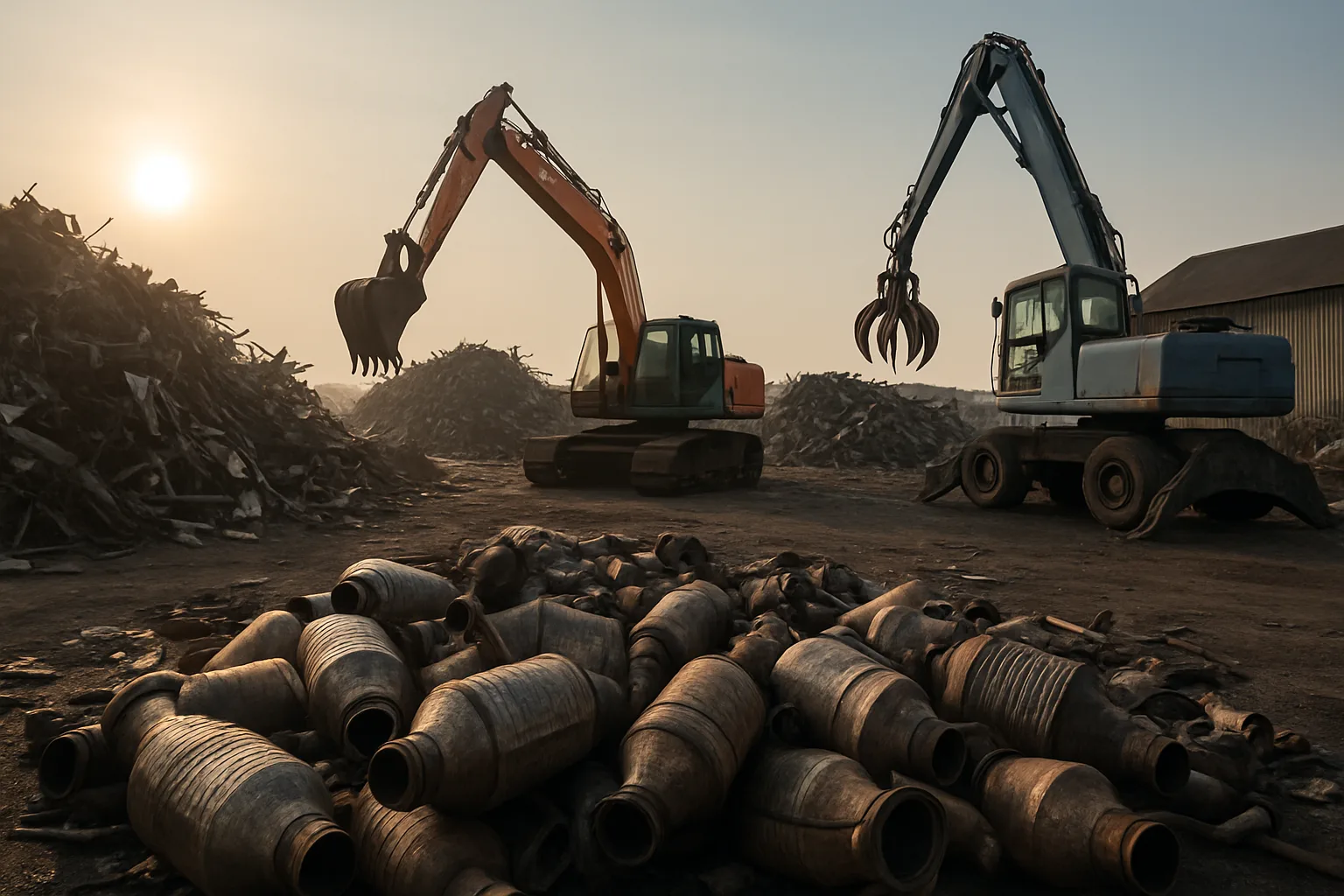
What's Actually Inside a Catalytic Converter — and Why Recyclers Pay So Much for Them
Most people know catalytic converters are worth money. Few know why. Inside that ceramic honeycomb substrate are platinum group metals — platinum, palladium, and rhodium — and those three elements drive one of the most volatile pricing markets in the scrap world. On any given day, rhodium alone can swing hundreds of dollars per troy ounce. That's why the price you're quoted for a catalytic converter can feel completely random if you don't understand what's driving it.
This article breaks down how catalytic converter recycling actually works, what determines the value of each unit, and how sellers in Grand Forks and across North Dakota can stop leaving money on the table when they have cats to move.
How Catalytic Converter Recycling Works: From Removal to Refinery
The recycling process isn't complicated, but most sellers never see past the first step. Here's what actually happens after a converter leaves your yard:
- Collection and sorting. Converters are sorted by type — OEM (original equipment), aftermarket, foreign domestic, or diesel. Each category has different PGM concentrations and different base values.
- Decanning. The outer steel shell is cut away to expose the ceramic or metallic substrate inside. The steel shell itself gets recycled separately as scrap steel.
- Processing. The substrate is crushed, sampled, and assayed to determine exact PGM content. This is called "lot sampling" and it's where the real number gets established.
- Refining. A licensed smelter extracts the platinum, palladium, and rhodium. This process takes weeks, which is why full returns on a toll refining arrangement can take 30–60 days.
- Settlement. Sellers who work on a revenue-share or toll basis get paid based on the confirmed assay. Buyers who purchase outright absorb that risk themselves.
Most scrap yards and dismantlers never see steps three through five directly — they sell to a middleman or a catalytic converter buyer who handles downstream processing. That layered structure is exactly why using a B2B scrap metal marketplace can make a real difference. More buyers competing for your load means the spread between what you receive and what the refinery pays gets compressed. That's price discovery working in your favor.
Why Catalytic Converter Prices Vary So Much
Walk into two different scrap yards and quote the same serial number. You might get two wildly different prices. That's not a mistake — it's the market. Several factors drive the variation:
- PGM spot prices. Platinum, palladium, and rhodium trade on global commodity markets. Daily price swings are normal. A load quoted on Monday morning may look different by Friday afternoon.
- Converter type and grade. A high-grade foreign domestic converter from a luxury vehicle contains significantly more PGM loading than a generic aftermarket unit. Buyers who use VIN lookup and serial tracking pay more accurately — and typically pay more.
- Buyer risk tolerance. Some buyers price conservatively to protect margin. Others are willing to pay closer to market because they move high volume. Competition forces the aggressive pricers to the surface.
- Aftermarket vs. OEM. Aftermarket converters are generally lower value. If a yard is quoting your OEM converters at aftermarket rates, you're losing money on every unit.
- Market timing. Catalytic converter prices dropped sharply from their pandemic-era peaks. In 2026, the market has stabilized somewhat, but palladium and rhodium prices remain sensitive to automotive production trends and EV adoption rates. Always check current rates before you commit to a sale.
The bottom line: price variation isn't random. It reflects real differences in buyer capability, data quality, and risk appetite. The way to get a better number is to create competition. A catalytic converter auction format does exactly that — multiple vetted buyers bid on the same load, and you see what the market actually thinks your inventory is worth.
What Sellers in Grand Forks Should Know About Moving Cats Competitively
If you're operating a dismantling yard, auto recycler, or dealership in Grand Forks, your geographic position matters more than most sellers realize. You're not landlocked from national buyers — you're accessible by freight, and serious catalytic converter buyers across the country will move on a good load. The idea that you have to take whatever the closest scrap yard near you offers is outdated.
That said, logistics are real. Here's what smart sellers in North Dakota do to maximize converter value:
- Document everything before you ship. Photos of each unit, serial numbers where visible, converter type classification. Buyers pay more when they have confidence in what they're receiving. Platforms like SMASH support photo documentation and serial tracking that gives buyers exactly that confidence.
- Sort before you list. Don't mix high-grade OEM units with aftermarket in the same lot unless you have to. Sorted loads get better prices because buyers can underwrite them more accurately.
- Understand the difference between a spot quote and an assay-based return. Spot quotes give you certainty now. Assay-based returns can be higher — but the outcome depends on what comes back from the refinery. Know which structure you're agreeing to.
- Use a B2B scrap metal marketplace instead of a single buyer. One phone call, one quote, no competition. That's not price discovery — that's guessing. Running a competitive process on a platform built for this is a completely different experience.
Sellers in Grand Forks have access to Grand Forks scrap metal services designed to connect local inventory with buyers who compete on price — not just whoever happens to answer the phone first.
The Role of a B2B Scrap Metal Marketplace in Catalytic Converter Sales
A B2B scrap metal marketplace changes the equation for anyone moving catalytic converters at volume. Instead of calling one buyer, listing your inventory on a structured platform puts it in front of multiple vetted buyers simultaneously. That structure — competition, transparency, documented inventory — is what drives better price discovery.
SMASH is built specifically for this. Yards and dismantlers list their converters with photos, serial numbers, and type classifications. Vetted buyers bid. The seller sees competing offers in real time. There's no subscription fee — SMASH only wins when the seller wins. Auto-invoicing handles the paperwork, and the platform supports scrap metal recycling workflows that larger B2B sellers already expect.
If you're currently getting one quote for your cats and accepting it, you don't actually know what your inventory is worth. You know what one buyer was willing to offer on that day. Those are very different things. Get competitive bids for your scrap metal and find out what the market actually says your load is worth.
Platforms like SMASH make it practical to sell your scrap metal at top prices on Sell Scrap Metal without overhauling your entire operation. You list the load, buyers compete, you choose the best offer. That's it.
Scrap Metal Recycling in North Dakota: Getting the Most From Every Load
Catalytic converters don't sit in a vacuum. Most yards and dismantlers in North Dakota move a mix of material — scrap copper from wiring harnesses, scrap aluminum from engine blocks and wheels, scrap steel from frames and body panels, and cats from the exhaust system. The same principles apply across all of it: documentation, competition, and price transparency.
Here's what experienced sellers do differently:
- They separate non-ferrous from ferrous before pricing. Mixing copper, aluminum, and steel into a single bin quote almost always means leaving money behind.
- They track market movements. Scrap metal prices shift with global commodity markets. Selling strategically — not just when storage gets full — adds up over a year.
- They use platforms that handle BOLs and packing lists automatically. Administrative friction costs real money at volume.
- They think of buyers as a portfolio, not a single relationship. No single buyer wins on every load. Competition keeps everyone honest.
If you want to explore scrap metal selling guides that go deeper on pricing strategy, sorting, and documentation best practices, there's more to learn beyond what fits in one article.
When you're ready to move your next load — cats, non-ferrous, or a mixed yard pull — get a fair price for your scrap today and let competition do the work for you. Sell your scrap metal at top prices by requesting a pickup at sell-scrapmetal.com.
Disclaimer: Catalytic converter prices and scrap metal prices fluctuate daily based on PGM spot markets and commodity conditions. Always verify current rates before committing to a sale.
Frequently Asked Questions
Q: How do I know if I'm getting a fair price for my catalytic converters in Grand Forks?
The only way to know your converter's true market value is to get multiple competing offers. A single quote from one buyer tells you what that buyer wants to pay — not what the market will bear. Using a B2B scrap metal marketplace puts your inventory in front of multiple vetted buyers and lets competition establish the real price.
Q: Why do catalytic converter prices change so often?
Catalytic converters contain platinum, palladium, and rhodium — precious metals that trade on global commodity markets every day. When PGM spot prices shift, converter values shift with them. Aftermarket production trends, EV adoption rates, and mining supply all feed into those price movements. Check current PGM spot prices before you list or ship a load.
Q: What's the difference between a spot quote and an assay-based return for catalytic converters?
A spot quote gives you a fixed price upfront — the buyer takes on the assay risk. An assay-based return means you're paid based on what the refinery actually recovers from your lot, which can be higher or lower than a spot quote depending on the actual PGM content. Both structures are legitimate; the right choice depends on your risk tolerance and how well you know your inventory.
Q: Can sellers in North Dakota access national catalytic converter buyers, or are they limited to local options?
National buyers absolutely move on good loads from North Dakota — freight logistics are well-established and serious buyers aren't limited by geography. Platforms like SMASH connect sellers in any region with vetted buyers across North America, so you're not stuck accepting whatever the nearest local yard offers.
Q: Does documentation really affect the price I get for catalytic converters?
Yes — significantly. Buyers price in uncertainty. When you submit a lot with clear photos, serial numbers, and accurate type classifications, buyers can underwrite it more precisely and bid more aggressively. Undocumented or mixed lots get discounted to protect against unknown risk. Good documentation is one of the simplest ways to improve your returns without changing anything else about your operation.
---Stay current on scrap metal market trends and pricing updates — follow SMASH on LinkedIn for industry insights, market moves, and practical advice for scrap sellers across North America.